The quest to cultivate food beyond Earth’s atmosphere hinges on mastering the science of water purification and recycling. Successful extraterrestrial farms rely on closed-loop systems that deliver reliable, pathogen-free water to plants in environments where every drop counts. This article explores the unique challenges of sourcing water in space, the cutting-edge technologies that underpin effective water filtration, and how integrated recycling systems tighten the feedback loop between waste and resource.
Water Source Challenges in Space Environments
Extracting and treating water off-world demands innovative approaches tailored to extreme conditions. Unlike terrestrial agriculture, extraterrestrial farms cannot tap into aquifers or reservoirs. Instead, potential water sources include:
- Ice deposits in lunar craters or Martian poles
- Reclaimed wastewater from crew habitats
- Atmospheric condensation units on planets with significant humidity
Each source presents its own set of obstacles. Lunar ice may harbor mineral contaminants and cosmic radiation products, while Martian water ice contains perchlorates that are toxic to plants. Atmospheric condensate can carry dust particles and microbial life from the surrounding environment. Achieving reliable extraction and pre-treatment is the first critical step before any membrane or biological filtration can occur.
Lunar and Martian Water Composition
Studies of regolith samples have revealed that lunar ice often coexists with silicates and trace metals. On Mars, perchlorate levels can reach parts per million, necessitating robust chemical removal processes. A typical treatment sequence may include:
- Initial thawing or condensation
- Gravity-driven sedimentation to remove particulates
- Chemical neutralization of heavy metals and salts
Research into regolith-based prefilters suggests that volcanic ash analogs could be used to adsorb certain ions. These natural materials can act as a first line of defense, reducing the load on high-energy filtration units.
Advanced Filtration Technologies for Extraterrestrial Agriculture
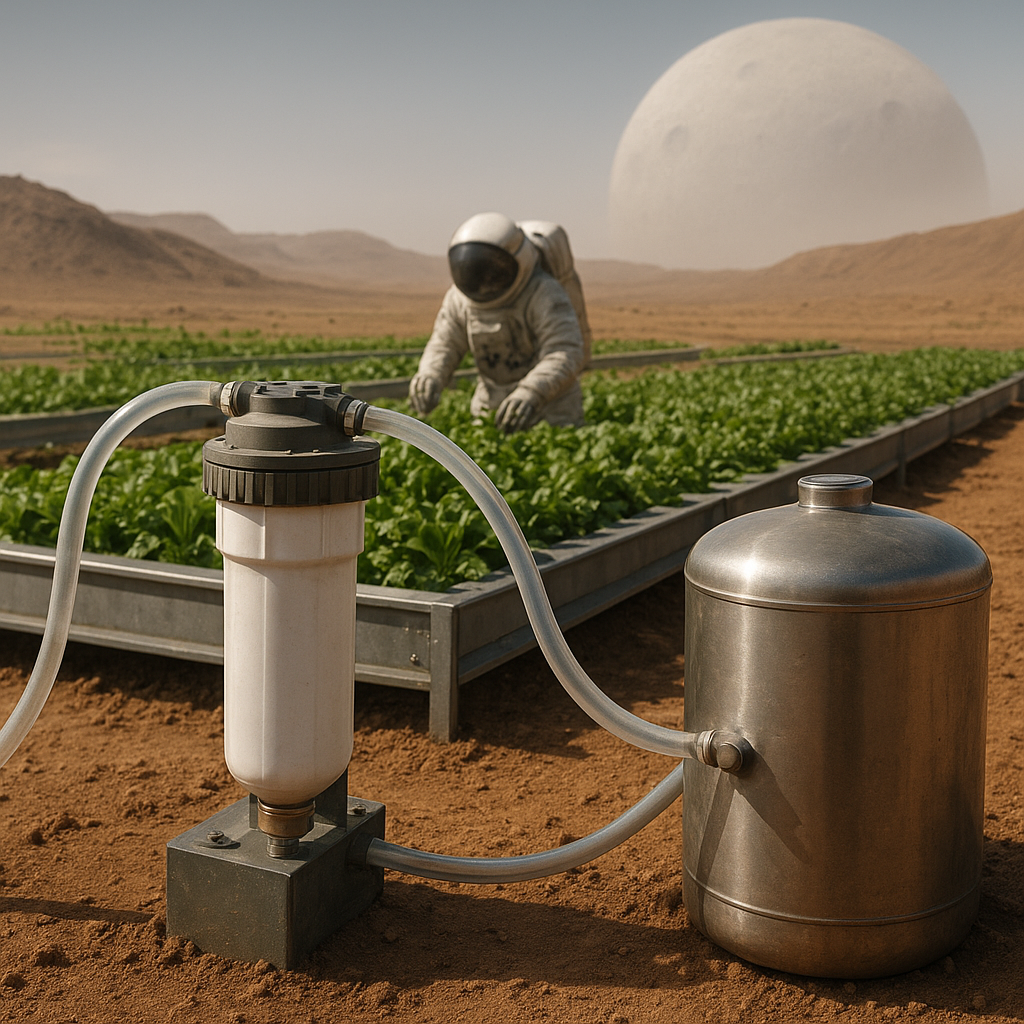
Once pre-treatment addresses bulk contaminants, advanced systems refine water to levels safe for sensitive root systems. Key technologies include:
- Membrane Filtration: ultrafiltration and nanofiltration membranes capable of rejecting bacteria and large organic molecules
- Reverse Osmosis: high-pressure systems to remove dissolved salts and perchlorates, though energy demands must be balanced against resource availability
- Bioreactor Modules: microbial consortia that degrade trace organics and recycle nutrients into plant-available forms
- Photocatalytic Oxidation: ultraviolet or solar-driven processes to neutralize viruses and persistent chemicals
Energy Efficiency and System Integration
Space missions have strict power budgets. Consequently, filtration units must maximize throughput while minimizing energy consumption. Strategies to achieve this include:
- Recuperative energy exchange between high-pressure and low-pressure flows
- Modular designs allowing incremental scaling based on farm size
- Hybrid systems combining physical and biological processes to reduce reliance on electrical pumps
Innovations in low-fouling membrane materials are crucial. Novel polymers and surface coatings inspired by shark skin or lotus leaves help maintain high permeability and extend maintenance intervals. The use of osmosis-based methods also opens possibilities for passive operation by exploiting pressure differentials in habitat structures.
Integrating Water Recycling Systems with Crop Cultivation
Beyond filtration, true sustainability demands symbiosis between water treatment and plant growth. Closed-loop water circuits must recover plant transpiration and metabolic by-products, converting them back into irrigation-grade water. Key elements include:
- Condensate capture from greenhouse atmospheres
- Solid waste composting to return bound water and nutrients
- Real-time monitoring of water quality parameters such as pH, conductivity, and microbial load
By closely monitoring the reusability of treated water, mission controllers can optimize dosing schedules for nutrients, ensuring crops like lettuce, tomatoes, or wheat receive consistent hydration without buildup of harmful residues. Automated feedback loops adjust filtration rates based on plant water-use data, maximizing water conservation.
Hydroponics and Aeroponics Synergies
Hydroponic and aeroponic cultivation platforms accentuate the need for exceptionally clean water to prevent clogging of mist nozzles or biofilm formation on root surfaces. In aeroponics, nutrient solutions are aerosolized, making any residual particulates or microbes a direct threat to plant roots. Implementations often feature:
- Inline micron filters (<0.2 µm) to safeguard nozzles
- Periodic chlorination or UV sterilization cycles
- Sensor networks to detect turbidity spikes and auto-trigger maintenance routines
By leveraging the precision of these soilless systems, each gram of water and nutrient is used by the plant, rather than lost to evaporation or percolation. This efficiency is vital given the high cost of water transport and recycling in off-Earth habitats.
Future Directions in Water Management on Off-Earth Farms
Looking ahead, the integration of artificial intelligence and machine learning promises smarter water management. Predictive algorithms will analyze historical usage patterns to forecast plant water demands, adjusting filtration throughput to match real-time crop needs. Additional frontiers include:
- Development of self-healing membranes that autonomously repair minor tears
- In situ resource utilization (ISRU) approaches to convert asteroid or comet volatiles into purified water
- Bioengineered microbial strains that perform simultaneous water purification and nitrogen fixation
The synergy between these advances will ultimately reduce the logistical footprint of long-term missions. As humanity ventures to the Moon, Mars, and beyond, robust and adaptive water filtration systems will remain at the heart of sustainable extraterrestrial agriculture. Ensuring that each drop of recycled water meets exacting purity standards is not merely an engineering challenge—it is the cornerstone of off-world food security and human survival.